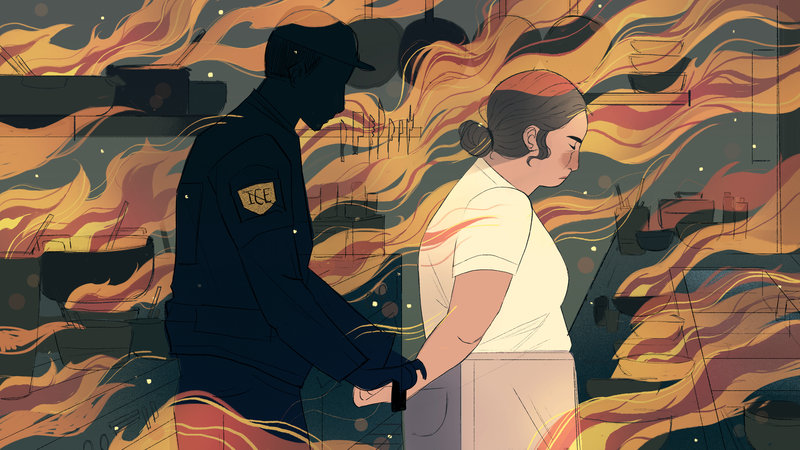
Citizenship, by definition, is the position or status of being a citizen of a particular country. Many immigrants endure the epidemic of being in immigration limbo. With politicians debating over border security and immigration, it is evident that the American immigration system doesn’t value fairness and equality. Historically, the United States has enacted restrictive exclusionary laws that have and continues to selective who’s socially acceptable to become an American.
The concept of citizenship, in theory, is a variable of a social construct. Citizenship is society’s recognition of political equality. A citizen is entitled to exercise their rights to the fullest degree and fulfill certain obligations. Over the years, the majority of Governments approach citizenship with a Focloaudian orientation claim where citizenship shapes the identity of one and forms subjectivity. This renders inclusion and exclusion because undocumented immigrants who reside in the US, are not likely to receive citizenship status even when they adopt the values of a group. (source)
The idea of citizenship creates a metaphorical border between those who are citizens and those who aren’t. Putting such limitations on residents in nations, is an ideology created by Governments. In her book, Impossible Subjects: Illegal Aliens and the Making of Modern America, Mae M. Ngai examines the history and contours of restriction on the entrance in a nation to undocumented people. Those who don’t have legal status in the United States are subjects that are never able to embark on the path to citizenship. Ngai states that “these trends are all evident in impossible subjects, in its analysis of the production of racial knowledge and national identity, the construction of the border, and the influence of colonialism on migration policy.” (Ngai) By constructing all these invisible borders, American culture has entrenched the tradition of exceptionalism; the idea that the US has is superior to all and will be making a huge difference in the world. As well, this way of thinking and being, encloses the community to a limitation of self-naming and subjectivity. There’s no concept of diversity in any of this but rather implicates citizenship is carefully orchestrated in order to proser.
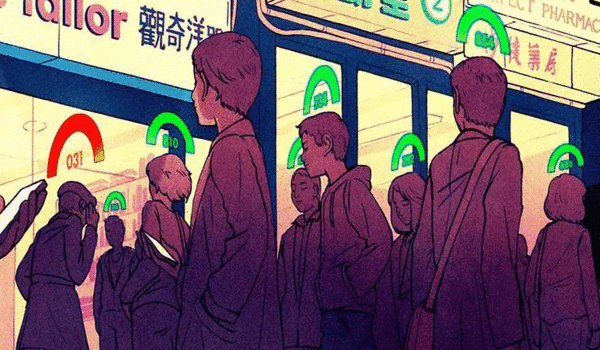
I have always considered myself an American even though I don’t have proper documentation. I comfortable with my personal self-cultivation, however, the Government would never fully acknowledge this. I am saying almost never because they know that there are many undocumented immigrants in the US who are willing to do anything in order to live the American Dream. The American Dream is an idea that is sold to foreigners to feel like it’s something they need. It’s said that if you want to be rich, the United States is the place to go to accomplish it. The idea of the United States was built upon the principle and practice where it accepts immigrant inclusion, however, normalizing immigrants who have no proper documentation and exploiting them to rigorous work for economic purposes is atrocious. Casting illegal immigrants and making them live in the shadows of a liberal society show how these are subjects that are in the “presence in s social reality yet a legal impossibility.” (Ngai)
Everywhere you go, immigrants are there. They are your janitors, teachers, scientists, peers, friends, etc. If these 12 million undocumented people ever got the chance of ever becoming citizen they would impact the political orientations in order to shape and develop the underrepresented groups. The United States offers great respect for humanity with equal rights for all but at the same time, it’s highly punitive when it creates materialistic and invisible borders to exclude groups. In No Borders, Indigenous Sovereignty, Dylan Miner questions why we have borders that construct the idea that one must be accepted in to feel included. Miner suggests that we should create “worlds without limitation and commerce building new worlds- based on the teaching of the ancestors that is not overdetermined or delimited by settler-colonial and capitalist constraints.” (Miner) Suggesting that we should come an agreement to abolish these materialistic and spiritual borders and think beyond them in order for us to be seen as a whole and prosper together. While I do agree that the idea of citizenship is overdetermined by the Government to control society, I don’t believe we are at the point where everyone is educated enough to see the inequality and unjust of this idea. There are so many citizens who don’t understand how privilege they are to vote and exercise their rights to the fullest degree. It’s within the power of those who are educated and informed to teach others about the complexity of immigration because the country is for the country and not by the government.
 Site Title
In my Intro to American Studies class this quarter, we discussed a lot about how exclusive the United States is. The US has the image of being a “melting pot”, however, there are so many restrictions on immigrants in the country. In my opinion, the process for becoming a citizen in the United States is too strict. Growing up in a very diverse city, I was shocked when I found out many of my friends were not US citizens, even though they have grown up in the US basically their whole life. These friends are unfortunately not allowed to vote, as you mentioned. It is upsetting that there are people who have been living in the US for a very long time, and are very americanized, yet they are not considered equals in our society and are not allowed to vote. I believe the process of becoming a US citizen should be easier.
LikeLike